
- +91 98678 06886 | +91 76661 14785
- info@limrainstruments.com
- Vasai (E), Maharashtra
OIML Standard Weights Box Class E1-E2
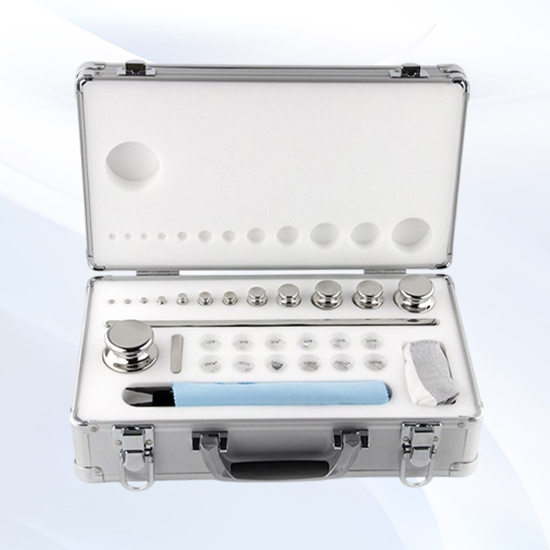
Reference Accuracy for Advanced Calibration
In high-precision laboratories, accuracy is not estimated — it is verified. Limra Instruments manufactures OIML Standard Weights Boxes - Class E1 and Class E2 in India, engineered for ultra-precise calibration of analytical balances and high-resolution weighing instruments.
Designed according to international OIML recommendations, our E1 and E2 weight sets provide traceable, stable, and reliable mass standards for demanding metrology environments.
Understanding OIML Class E1 & E2 :
OIML (International Organization of Legal Metrology) defines strict tolerances for calibration weights.
- Class E1 :
Class E1 Used for calibration of ultra-micro and high-precision analytical balances.
Offers extremely tight tolerance limits and superior surface finish. - Class E2 :
Class E2 Suitable for calibration of high-precision laboratory balances and as reference standards for F1 class weights.
Limra Instruments manufactures both classes with strict adherence to precision machining and finishing standards.
Manufactured for Metrology Excellence :
Our OIML standard weights are produced using:
- High-grade non-magnetic stainless steel
- Mirror-polished surface finish
- Controlled density material
- Precision mass adjustment techniques
Each weight is individually verified for dimensional and mass stability.
Features of Limra OIML Weights Box :
- Class E1 and E2 tolerance compliance
- Mirror-polished stainless steel construction
- Laser marking for identification
- Protective wooden / aluminum storage box
- Anti-static and corrosion-resistant finish
- Supplied with handling accessories (tweezers, gloves as required)
- Individual weight cavity protection
The storage box is designed to protect weights from dust, humidity, and mechanical impact.
Applications :
Limra OIML Standard Weights Boxes are widely used in:
- NABL-accredited laboratories
- Pharmaceutical quality control labs
- Research institutions
- University science laboratories
- Calibration service providers
- Industrial metrology departments
They serve as primary or secondary reference standards depending on application.
Precision Manufacturing Process :
Every set undergoes :
- Controlled machining
- Fine mass adjustment
- Surface finishing
- Tolerance verification
- Stability testing
Only weights meeting strict internal quality benchmarks are assembled into the final box.
Available Configurations :
Limra Instruments offers various combinations such as:
- 1 mg to 100 g sets
- 1 mg to 200 g sets
- 1 mg to 500 g sets
- Customized combinations as per laboratory requirements
Custom configurations can be developed based on client specifications.
Storage & Handling Protection :
To maintain calibration integrity:
- Each weight is stored in precision-cut cavities
- Anti-moisture lining protects internal surfaces
- Secure locking system ensures transport safety
Proper storage helps preserve long-term mass stability.
Why Choose Limra Instruments?
- Indian manufacturer with precision engineering expertise
- OIML-compliant tolerance manufacturing
- High-quality stainless steel construction
- Reliable and repeatable calibration standards
- Customizable weight set configurations
- Dedicated technical support
We focus on delivering mass standards that laboratories can depend on.
Trusted OIML E1 & E2 Weights Box Manufacturer in India :
If your laboratory demands uncompromised calibration accuracy, Limra Instruments offers dependable OIML Class E1 and E2 Standard Weights Boxes designed for precision and long-term reliability.
Contact us today to discuss your calibration requirements and receive a customized quotation.
Technical Specifications :
| Class | E1 / E2 (1mg - 200gm) |
| Standard | OIML R111 |
| Material | Austenitic Stainless Steel/316 Stainless Steel |
| Construction | Solid single piece fabrication |
| Cavity | No Cavity adjustment |
| Density | 8.00g/cm³ / 7.96g/cm³ |
| Magnetic Susceptibility | < 0.005 |
| Intensity of Polarization | < 2.5 <8 |
| Shape | Cylindrical with knob / Cylindrical |
| Finish | Mirror Polish / Mirror |
| Packing Sets Weight | Aluminium alloy box |
| Packing Individual Weight (kg) | ABS Box (20kg, 10kg, 5kg, 2kg, 1kg) |
| Packing Individual Weight (g & mg) | ABS Box (500g to 1g & 500mg to 1mg, any) |
Frequently Asked Questions
What are OIML Class E1 and E2 weights and who needs them?
E1 and E2 are the two highest accuracy classes of OIML calibration weights. E1, the most precise, calibrates E2 weights and reference standards at national metrology institutes. E2 is used for analytical and precision reference balances in pharma and research labs. If your balance reads to 0.001 g or finer, Class E or F weights are what you need.
What materials are OIML Class E1 and E2 standard weights made of?
They're made from high-grade, non-magnetic stainless steel (typically AISI 316L) with a finely polished, mirror-like finish that minimises dust accumulation and contamination effects. The material quality and machining precision required for E1/E2 class is significantly higher than lower classes.
Does Limra Instruments supply OIML Class E1/E2 weight sets with calibration certificates?
Yes, with calibration certificates traceable to national standards. For pharma, metrology labs, and NABL-accredited facilities, this documentation isn't optional it's part of your audit trail. Let us know at enquiry whether you need a factory certificate or an accredited third-party NABL certificate, since traceability requirements differ.
How are E1/E2 standard weights stored and handled to maintain their accuracy?
Never handle them with bare hands skin oils and minor abrasion can affect ultra-high-accuracy measurements. Use clean cotton gloves or calibrated tweezers, and store in the original padded case away from magnetic fields, moisture, and temperature extremes. Annual recalibration catches any drift early. Limra supplies weights with appropriate carrying cases.
What is the difference between OIML Class E, F, and M weights and which one do I need?
These classes range from most precise (E1/E2) to least precise (M1-M3). E weights suit reference and lab balances; F weights suit pharma, jewellery, and general lab balances; M weights suit commercial and industrial scales used in trade. Simple rule: milligram-reading balances need E or F class; gram-reading scales need F or M. We can confirm the right class for your model.